
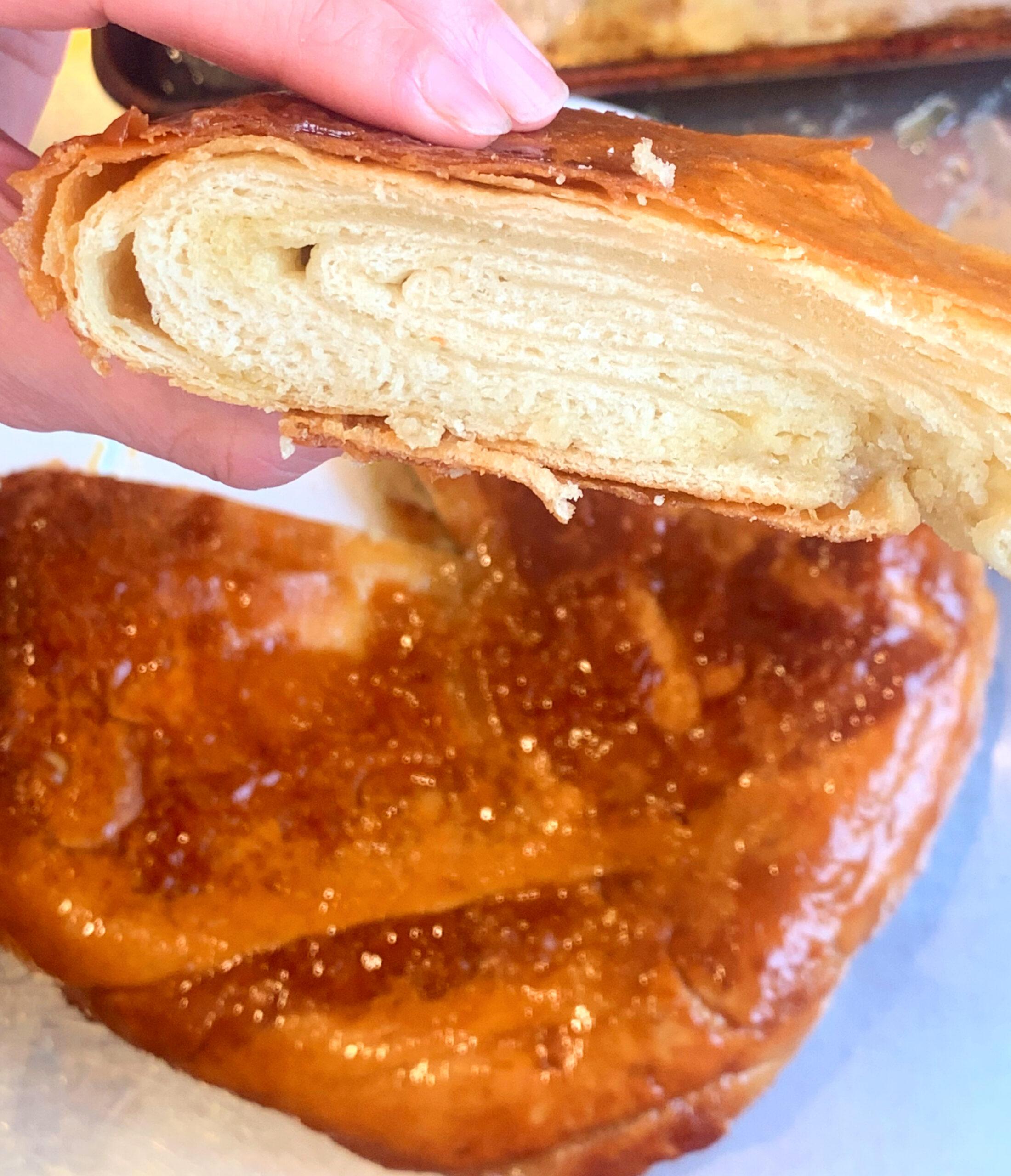
This Kouign Amann pastry is like an orange coffee cake and cinnamon croissant had a giant salty sweet baby. Its cakey and flaky, and the flavors are deep and intriguing. Kouign Amann (pronounced Queen Amaan). Kouign Amann is a large, cake-like salty-sweet or savory laminated pastry that originated in Breton. (You may have seen cupcake-sized sweet folded croissants called “Kouign Amann” in American bakeries, and those are just as (in)authentic as the recipe here).
If you love Viennese pastries, and maayyyybe you’ve considered, mayyyyybe learn about laminating dough, but really you don’t want to sacrifice pounds of butter to inedible croissants (butter is expensive as shit!), then I cannot recommend this recipe enough. This simplified version of Kouign Amann is the best kind of teaching tool because even if you fail at laminating dough, you’ll get a heck of a decedent coffee cake out of it. Seriously, you can shred this dough or have perfect lamination and it’s a great either way. Give this cake a try. It is actually fun to fail at, learn, and get better at pastry when the results are so spectacularly delicious.
Notes
Note about salt, butter, and so much yeast!
Traditionally, this cake is made with salted, cultured butter. Because butter varies so much, and cultured butter is so expensive, I’ve chosen to use unsalted Kerry Gold European style butter here. I’d recommend you use a similar butter. Why the insane amount of yeast? The toasted sesame oil and the extra yeast are brilliant additions to this dough. The yeast and the bit of sesame oil mimic the slight earthy taste that you would get from cultured butter giving you a very consistent taste that I absolutely adore.
Note about the process
Because this recipe has a bunch of steps and I want the process to feel manageable, I’ve divided this recipe over two days.
DAY ONE takes less than an hour. You’ll make your 3 ingredients: dough, syrup, and butter packet.
DAY TWO takes less than 2 hours. You’ll laminate the dough and then bake it.
Notes about laminating dough
- If it’s cold, open a window in front of the counter where you’ll be rolling out your dough. Or put bags of ice water in the spot where you’ll be working to chill your counter before laminating dough.
- Butter should be about 10 degrees warmer than your dough before you begin the lamination process. It should feel a little “bendy” when you use it, and not like it will immediately snap.
- The measurements of the dough are only guidelines.
- Be firm slow when you roll your dough. If you’re pushing and tugging the dough it will rip! If the dough seems to be fighting you, walk away for 5 minutes and let the dough rest.
- Remove all jewelry! I often forget to remove my wedding ring and it has caused some preventable tears.
- Be kind to yourself, do not attempt this on a hot day without air conditioning! You want a kitchen between 68-74 degrees.
Key Ingredients
unsalted European style butter
all-purpose flour
orange peel
instant yeast
granulated sugar
toasted sesame oil
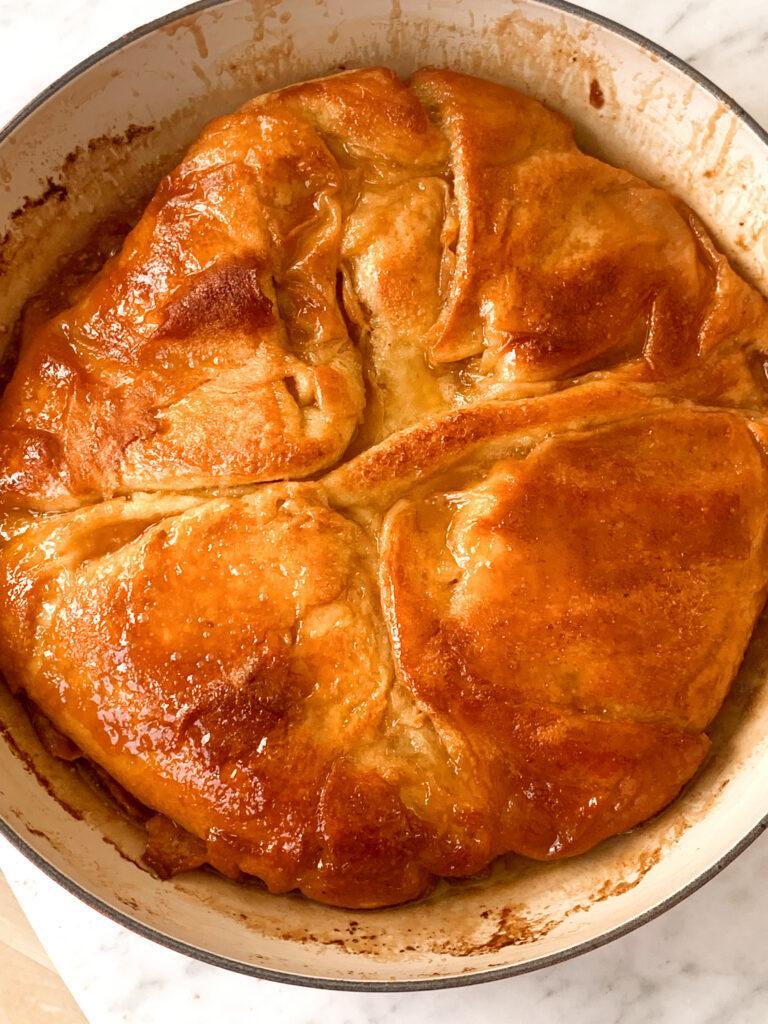
Flaky-Cakey Kouign Amann– Recipe
This cake serves 12 dignified individuals. My family of 5 likes to try and eat the whole damn thing. Special equipment: 12 inch oven-proof skillet, fine strainer, rolling pin. Suggested: stand mixer, bags of ice water. Adapted from the New York Times Kouign Amann recipe by Yewande Komolafe
Ingredients
Orange Syrup
- ¾ cup granulated sugar
- 2-3 1-inch-wide strips of orange peel with as little pith as possible
- ½ teaspoon cinnamon
- ¼ teaspoon ginger
- 3 whole cloves
- 1 teaspoon vanilla paste or 1/3 of a split vanilla bean
Dough
- 1 and 1/3 cup warm water
- 6 teaspoons of instant yeast (or 3 packets is fine)
- 3 and ¾ cups all-purpose flour (450 grams)
- 1.5 teaspoons fine sea salt
- ¼ cup unsalted European-style butter at room temperature (I use Kerry Gold)
- 1 teaspoon toasted sesame oil
Butter Packet
- 1 and ¼ cup unsalted European style butter
- 1 cup granulated sugar (fine sugar is better than course)
- 3/4 teaspoon fine sea salt
- PLUS extra flour for dusting the work-surface and 1 tablespoon unsalted butter for greasing the pan
DAY 1: dough, orange syrup, and butter packet (about 1 hour)
Step One
About 2 hours before you want to start making your dough and butter packet, set out 1 and ½ cups butter (3 sticks) to come to room temperature. You’ll need less time in a hot kitchen, more in a cold one.
Step Two
Make the orange syrup: Combine all ingredients (except if using vanilla paste) with 2/3 cup water in a small saucepan. Bring mixture to a gentle boil for 2 minutes. Turn off heat, (add vanilla paste if using), and let cool about 30 minutes, then strain into a small jar or measuring cup, cover, and refrigerate until needed (tomorrow).
Step Three
Make the dough: Using a large mixing bowl, or, ideally, the bowl of a stand mixer, dissolve 6 teaspoons of instant yeast (or 3 packets) in 1 and 1/3 cups warm water. Once the yeast is mostly dissolved, add 3 and ¾ cups (450 grams) of all-purpose flour and 1 and 1/2 teaspoons of fine sea salt. Mix by hand or with a dough hook until you get a shaggy dough (about 1 minute)
Add in the ¼ cup unsalted butter cut into a few chunks and 1 teaspoon toasted sesame oil to the dough. Kneed on low with stand mixer (or by hand) about 8 minutes. If using a stand mixer, you’ll need to attend the dough the whole time, making sure the dough hook is getting ALL the dough and that it’s not just massaging the top. By 8 minutes the dough should look relatively smooth and the butter should be fully incorporated. Put the dough ball in a freezer bag or airtight container and allow to rise for 8-24 hours in the fridge.
Step Four
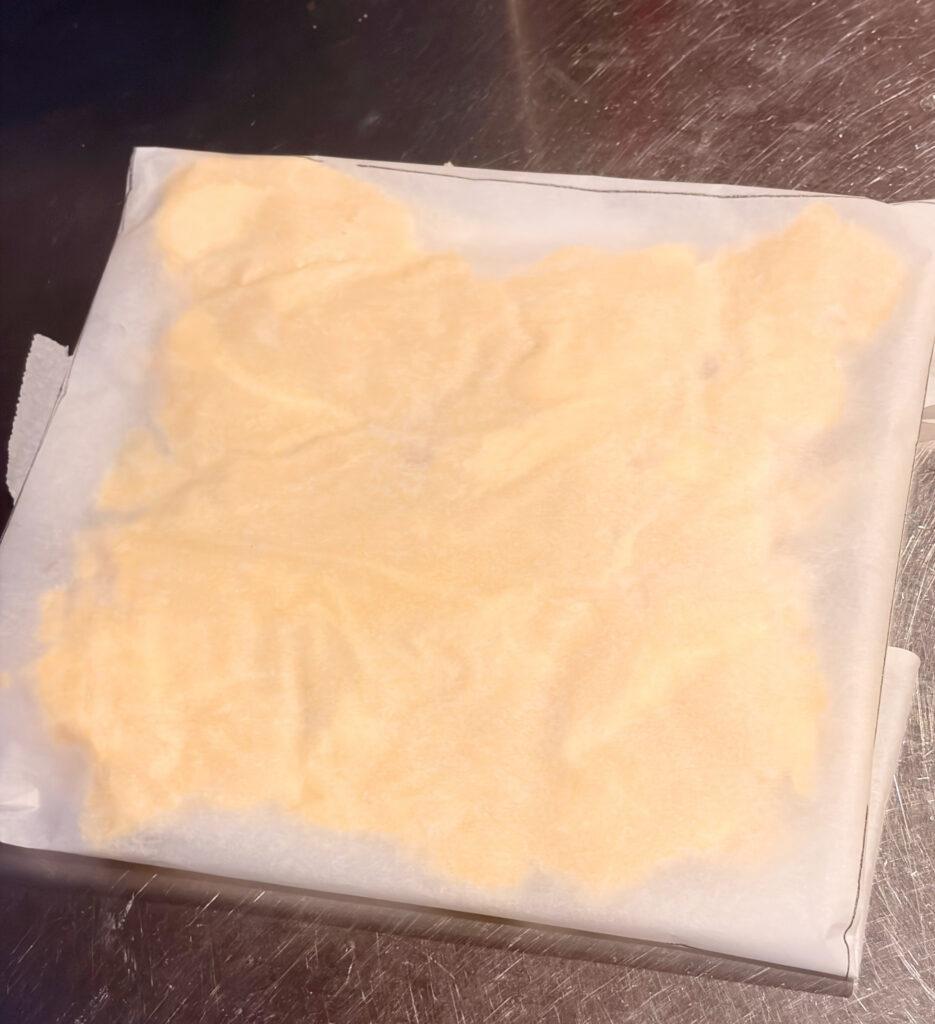
Make butter packet: cut out a large piece of parchment paper (about 12″x 18″) and draw a 9×9 inch box on the paper. Set parchment aside. Using a stand mixer, or by hand with a stiff spatula, mix together the remaining (softened) 1 and ¼ cup butter and 1 cup granulated sugar. Once mixed, place parchment paper drawing side down (you should still be able to see the box) and spread butter on the parchment paper. Once the butter is somewhat close to the edges of the box drawing, fold the parchment paper around the butter following the outline of the box, then gently use a rolling pin to evenly spread the butter into the shape of the box. Wrap your parchment butter packet in plastic wrap and put it in the fridge. (See photos below)

DAY TWO: Make the Cake
Step One
I highly recommend if it’s cold out, cracking a window near where you’re working, OR if it’s not cold, filling a two gallon freezer bags about 1/3 full with ice water, and then placing those on your counter.
Step Two
While you chill your counters, take butter packet out of the fridge and allow to warm slightly, about 8 minutes in a 70 degree kitchen, before you take your dough out of the fridge. While butter is warming, use the remaining 1 tablespoon of unsalted butter and generously butter the entirety of the 12 inch pan. Then pour 2-3 tablespoons of the orange syrup into the pan, and set both the syrup and the pan aside.
Step Three
Once your butter feels like it has a little flexibility, remove the ice bags from your workspace, lightly flour the workspace, and take your dough out of the fridge.
Step Four
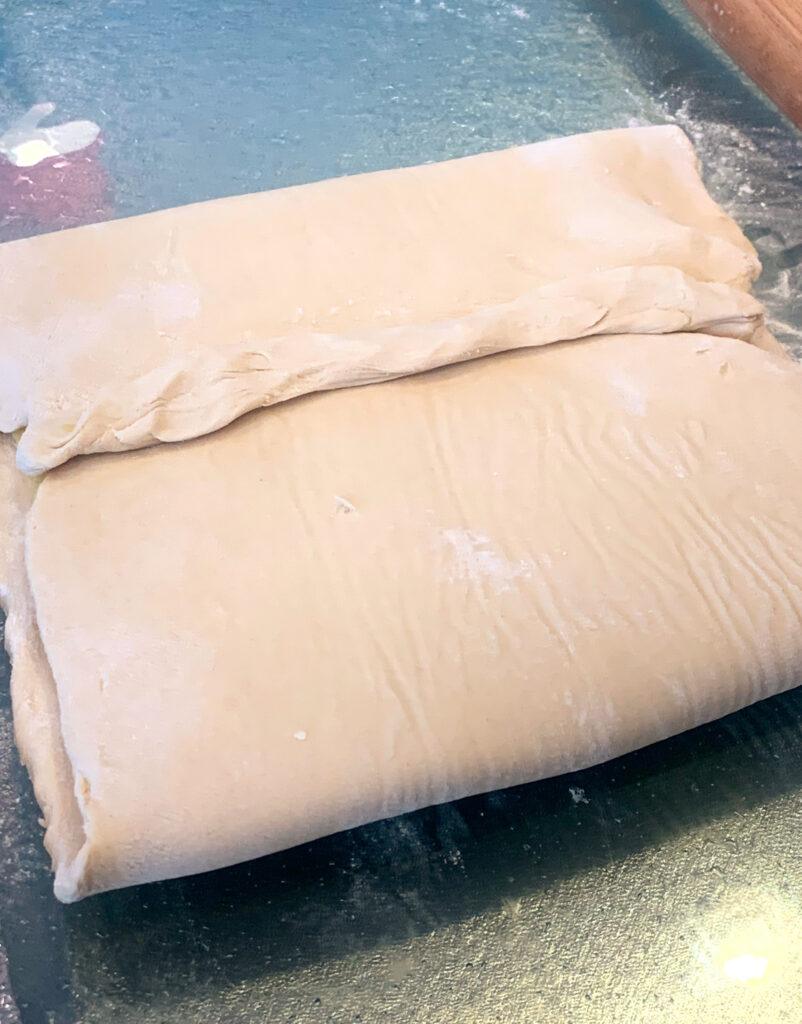
Remove the dough from the bag and set on the floured workspace. Lightly flour the top of your dough and roll out into about a 10 by 20 inch sheet. Place your butter packet in the middle of your dough, and then fold the dough up around the packet so the butter is entirely contained, brush off any excess flour from the dough, and then gently push the seams of the dough together. See photos below.

Step Five
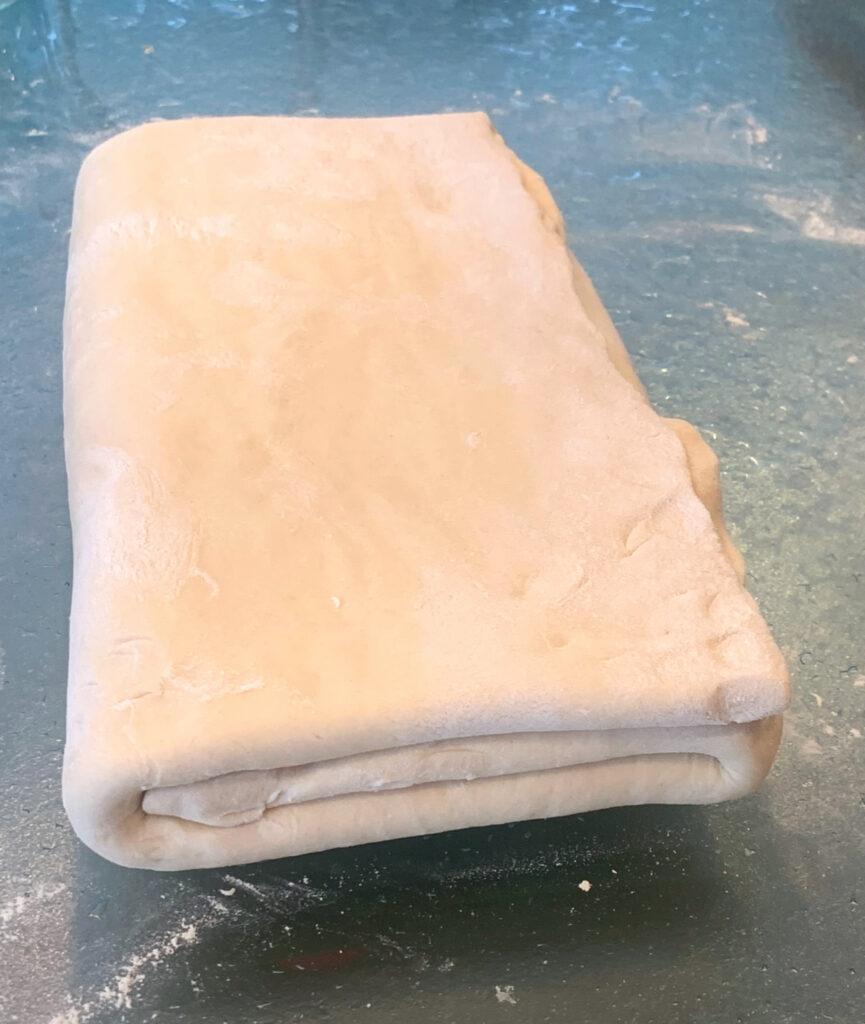
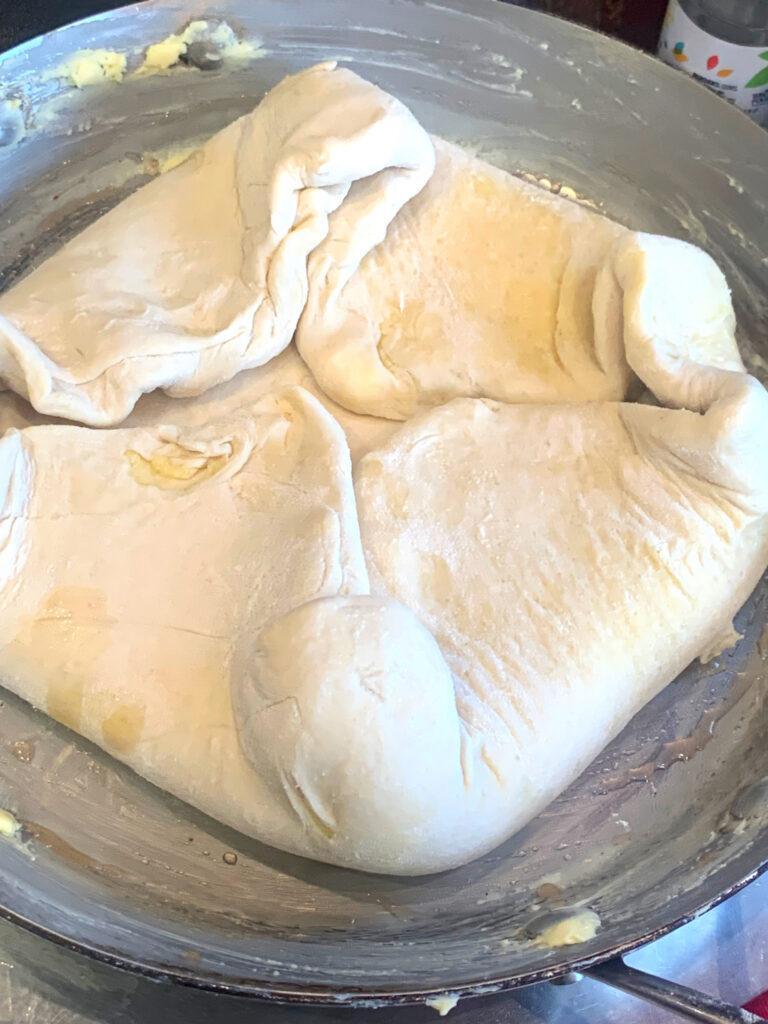
Check whether your dough is sticking to the counter, if so, sprinkle some more flour underneath. Then, roll the dough out, until you have about a 16×10 inch sheet, brush off any excess flour, and do a tri-fold for your dough. See photo below (folding your dough like a brochure). Roll the dough out again, this time to about a 14×10 inch rectangle, brush any excess flour off the dough and do another tri-fold, making sure to pinch together the seams. Then turn your dough 90 degrees (checking it’s not sticking to the counter), and roll it out one more time, this time aiming for a 14 inch square. If your dough is resisting or you think your butter is melting, transfer it to a plate and put it in the fridge for 5-10 minutes. Once the dough is rolled out in a 14 in square, fold in each corner of the dough to make a smaller square (as if you’re about to start making a fortune teller/cootie catcher). See middle photo below.
Step Six
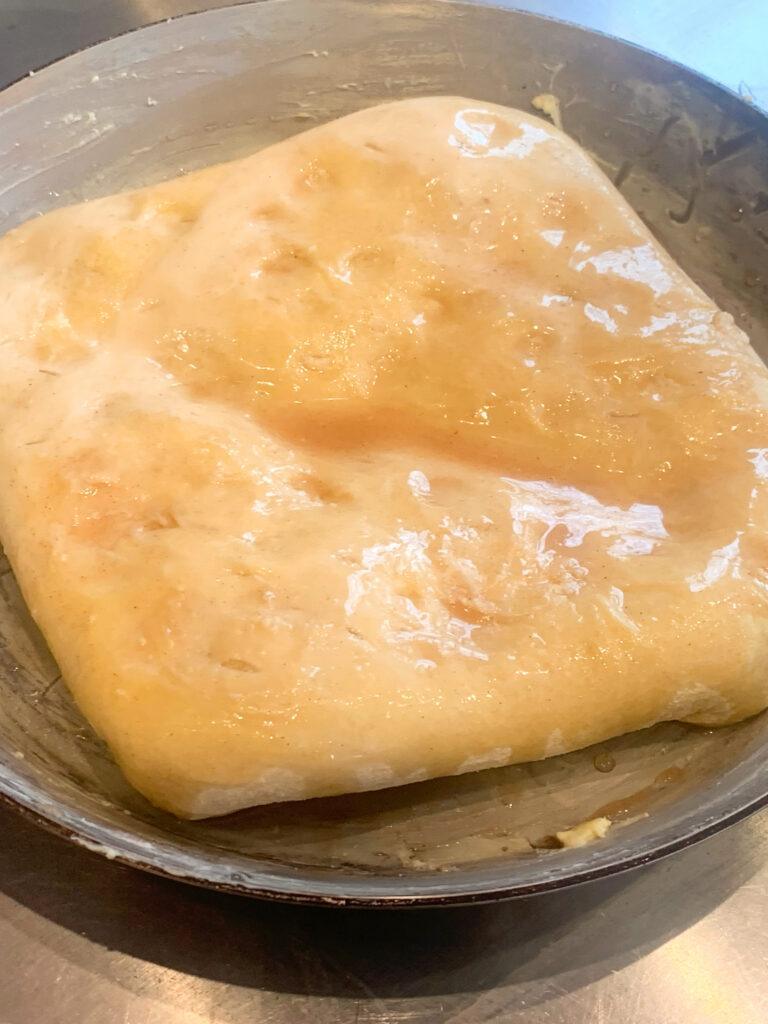
Flip your dough over so the folded corners of the dough are on the bottom, (flour your counter as needed) roll the dough out until the sides of the square reach about 11-12 inches (you can measure with your pan). Transfer the square into the pan with the folded sides down. Using a sharp knife, cut holes that go about ½ of the way through the top of your pastry. Then pour about ¼ cup of syrup over the top of the Queenie cake trying to get as much syrup into the wholes as possible. Cover the dough with pastic wrap or a small sheet of parchment paper, and then a tea towel and allow to rest for 30-45 minutes (see photo above). While the dough is resting, preheat the oven to 350.
Step Seven
Once the dough has rested for 30 minutes check to see if it looks a bit puffy and soft. If not, give it another 15 minutes. Once the dough is ready, remove the parchment and tea towel and bake for 35-45 minutes until the top looks golden and cooked. While it bakes, get out a sheet pan with a lip, 2 heat-proof spatulas, and a small measuring cup.
Step Eight
Flipping the cake: Remove the Queenie cake from the oven. Look to see how much butter is boiling around the sides. If there looks to be more than ¼ cup, carefully pour the butter off into a heat proof cup. Loosen the sides of the cake with a spatula, then flip the cake onto a RIMMED baking sheet. Add 2 tablespoons of orange syrup to the bottom of the pan. Then use those two spatulas to return the Kouign Amann, seams side up, to the pan. If you had to pour off less than 1/3 cup of butter, pour it back into the pan over the cake and around the edges. (If you’ve got more than 1/3 cup of butter, just pour in about 1/3 cup back in and set the rest of the sweet butter aside for another use.) Pour another ¼ cup of the orange syrup evenly over the cake and return it to the oven.
Step Nine
Bake for another 20-25 minutes until it looks evenly colored and if you CAREFULLY press on the top the cake doesn’t feel doughy. Remove from oven and let sit 1 minute. Then use spatulas to remove the cake from the hot pan and set on a rack or a plate to finish cooling.
Eat warm or at room temperature. It’s best eaten in the first day or two. But reheats marvelously in the oven or toaster oven.